

Doing hard things can feel rewarding because acting despite discomfort gives your brain evidence that fear and uncertainty don’t have to stop you. Research links the anterior mid-cingulate cortex to effort, motivation, and persistence. This helps explain why overcoming a challenge can leave you feeling capable and intensely alive.
In this article, we explore what happens in your mind on the edge of a bungy jump: the neuroscience of persistence, complete presence, and why fear can be helpful.
Already keen to move beyond theory? Experience the ultimate test of presence and persistence 134 metres above the Nevis River. Book your Nevis Bungy Jump today!
Growth, your nervous system, and the power of bungy jumping
At some point in personal development, knowing more isn’t the answer.
You’ve read the books. You understand discipline. You know that discomfort is necessary for growth. You know your thoughts aren’t always facts, fear doesn’t necessarily mean danger, and the life you want probably exists somewhere beyond what feels familiar.
You know all of this. Yet knowing something intellectually and experiencing it physically are two very different things.
Stand 134 metres above the Nevis River, and that distinction becomes very clear.
Your career doesn’t matter up there. Neither does your title, your income, how many books you’ve read, or how articulate you are over dinner.
Your nervous system has a much simpler assessment: There is an edge. Don’t step off it.
But then you do.
That’s why deliberately doing difficult things can be so powerful, particularly for people who have already spent years working on themselves. At some point, growth has to move beyond theory. It has to become embodied.
When Competence Becomes Comfortable
Success has an interesting paradox.
You spend years becoming good at things. You build knowledge. Experience. Confidence. Systems. Networks. You learn how to anticipate problems and minimise unnecessary risk.
Eventually, much of your life exists inside an environment you’re exceptionally well equipped to navigate.
That’s the reward for competence, but it can also become its limitation.
Because growth rarely asks us to demonstrate what we’ve already mastered.
It asks: Who are you when you don’t know exactly what happens next?
That question sits at the heart of many personal-development practices.
Cold exposure. Endurance events. Meditation retreats. Solo travel. Public speaking. Learning something completely outside your expertise.
Different practices. Similar principle. We deliberately enter situations where some of our usual certainty disappears. A bungy jump is a concentrated version of that experience.
There is nowhere to hide on the edge. No productivity system to optimise. No five-year plan. There’s just you, your nervous system, and a decision.
To jump or not to jump.
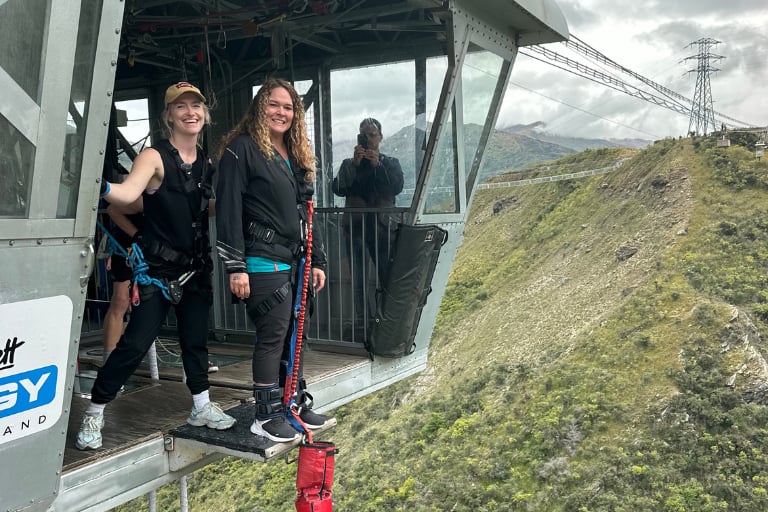
The Neuroscience of Persistence
An area of the brain has become increasingly interesting to researchers studying effort and persistence: the anterior mid-cingulate cortex, or aMCC.
A peer-reviewed review in Cortex describes the aMCC as a key network hub that integrates information about reward, effort, pain, threat, and the resources required to pursue a goal.¹
In other words, it’s implicated in one of the fundamental calculations behind achievement: This is difficult. Is it worth continuing?
The paper reviews research linking greater aMCC activity during difficult decisions to persistence and willingness to exert effort.¹
It would be tempting to turn that into a neat piece of motivational neuroscience and tell you that every difficult thing you do “grows your willpower centre.”
Science doesn’t support something that simple. What it does suggest is perhaps more useful: our capacity to pursue meaningful goals isn’t separate from discomfort. The brain is continually evaluating effort, cost, and reward as we decide whether to continue.
This raises an interesting question…
If every meaningful ambition eventually requires us to act while something feels difficult, how much of personal growth is really about removing discomfort? And how much is it about changing our relationship with it?
Fear Is Information. It Doesn’t Have to Be Instruction.
This is where the edge becomes interesting.
Fear is extraordinarily useful. It’s one reason you’re alive. But somewhere along the way, many of us start treating fear as evidence we shouldn’t proceed.
Sometimes that’s wise. Sometimes it can be limiting.
The work is learning to recognise the difference.
Kelly, one of our Taupō Bungy Jump Masters, remembers her first jump:
“I remember my first jump; it was amazing. I was nervous, but in my brain that was the whole point! If it weren’t a little scary, it wouldn’t be fun, and no one would do it! As soon as my feet left the platform, all that fear disappeared, and I felt like in that moment nothing else in the world mattered.”
That last sentence might be the most important. Nothing else in the world mattered.
While we talk a lot about fear in Bungy, people may really be experiencing presence.

The Luxury of Having Nowhere Else to Be
Most successful adults have become good at being in several places at once.
Physically, you’re having dinner. Mentally, you’re answering tomorrow’s email.
You’re exercising while consuming a podcast about becoming better at exercising.
We optimise almost everything, but presence resists optimisation.
And 134 metres above a canyon, the future becomes remarkably difficult to think about.
There is only the edge. Your breath. The countdown. Your heartbeat. Now.
People spend years practising meditation to cultivate the ability to remain completely present; Bungy takes a somewhat less subtle approach.
Build Evidence, Not Affirmations
David Goggins calls it the Cookie Jar.
The idea, popularised in Can’t Hurt Me, is simple: deliberately remember the difficult things you’ve already survived or accomplished and use them as evidence when you encounter the next challenge.
There’s something compelling about replacing affirmation with evidence.
Instead of: I think I’m capable of doing difficult things.
You have: I know I am, because I have.
Simon has watched it happen repeatedly around Bungy platforms:
“In order to bungy jump, you have to conquer your own mind and your own fear to be able to push through and actually take the leap. The feeling you get after winning that battle with your mind is ‘I did this, so I can do anything,’ and the more terrified someone is, the stronger that feeling is when they actually jump.”
The value isn’t necessarily in believing you can now literally do anything.
It’s in having another piece of evidence that your first internal response doesn’t have to determine your final action.
Fear said stop. You listened, considered it, and moved anyway.
Put that one in the Cookie Jar.
Live More Doesn’t Mean Do More
Live More. Fear Less doesn’t necessarily mean filling every weekend.
For people who already spend much of their lives striving, more may be the wrong metric.
Maybe living more means being more present for the life you’re already living.
Feel things fully, choose deliberately, and occasionally do something for no productive reason whatsoever beyond the fact that it makes you feel intensely, unmistakably alive.
And Fear Less?
That doesn’t mean eliminating fear either. A life without fear isn’t realistic, and probably isn’t desirable.
“Fear Less” means giving fear less authority.
It means recognising fear as information without automatically promoting it to decision-maker.
That practice extends well beyond a Bungy platform.
The Edge Is a Metaphor… Until It Isn’t.
Eventually, every life arrives at the edge.
Leave. Stay. Begin. Stop. Invest. Sell. Commit. Change.
The hard part is that important decisions rarely come with certainty.
You gather the information. You assess the risk. You listen to your instincts.
Eventually, a moment comes when thinking has done all it can. You have to move.
That’s why standing on a literal edge can feel profound. It compresses a familiar human experience into a few seconds.
You cannot intellectualise your way off the platform. At some point, you have to decide.
When you stand on the edge, nobody can promise you’ll suddenly understand yourself better.
You might have a profound revelation, or you might just scream something unprintable. Yet, for a few seconds, you will be completely present.
When your feet eventually return to solid ground, you take something with you. Evidence.
You felt fear without surrendering your agency to it. You encountered resistance and moved. You discovered that discomfort could exist without controlling the outcome.
Tomorrow, the emails will return, the meetings will continue, and life will become complicated again. Yet somewhere in your memory is an edge, and a version of you who stepped off it.
Live more and fear Less as a way of deciding who gets to run your week.
Ready to add a jump to your Cookie Jar? Stop letting fear call the shots. Step up to the edge, gather your evidence, and choose who gets to run your week. Book your Bungy experience.
¹ Source: Touroutoglou, A., Andreano, J., Dickerson, B.C. & Barrett, L.F. (2020). The Tenacious Brain: How the Anterior Mid-Cingulate Contributes to Achieving Goals. Cortex, 123, 12–29. DOI: 10.1016/j.cortex.2019.09.011.
FAQs:
Why do I feel so alive after a bungy jump?
For a few seconds, nothing else matters: no emails, no plans, just the edge, your breath and the countdown. Most of us rarely get to be that present. Add the rush of doing something your body told you not to do, and it’s no wonder people land buzzing.
Is it normal to be scared before a bungy jump?
Completely. Even our crew were nervous on their first jump, and for many of them that was part of the fun. Fear is your brain doing its job. The goal isn’t to get rid of it, just to make sure it isn’t the one making the decision.
What does the brain have to do with doing hard things?
Researchers have linked a part of the brain called the anterior mid-cingulate cortex to effort and persistence. It helps us weigh up whether something hard is worth pushing through. It’s not a willpower muscle you can build, but it shows how closely discomfort and achievement are connected.
What is the “Cookie Jar” idea?
It comes from David Goggins’ book Can’t Hurt Me. You remember the hard things you’ve already done and use them as proof when the next challenge comes along. “I’ve done harder” is far more convincing than “I think I can,” and a bungy jump makes a good one to add.
Will a bungy jump change my life?
We can’t promise that. You might have a big realisation, or you might just scream all the way down. What you’ll take home is proof that fear doesn’t get the final say, and that’s worth remembering next time a big decision feels hard.


