
There are many positive after-effects of bungy jumping, including heightened confidence, improved decision-making, reduced anxiety, and better emotional regulation.
When you move toward fear instead of avoiding it, you interrupt the anxiety loop and teach your brain a new response. Over time, that shift can rewire how you experience stress – reducing panic and avoidance while building confidence and self-trust.
Want the confidence to ask your boss for a payrise? Or perhaps you’re dreaming of staying calm when the children are tearing around the house… Maybe you want to find the guts to talk to the crush you’ve been pining over.
The solution. Do a bungy jump. (Yes, we’re serious)
People think bungy jumping is all about the moment you step off the edge. The freefall. The adrenaline. And sure, that part is wild.
But what most people don’t discuss is what happens afterward. Not five minutes after. Not when you’re watching the replay. But days… weeks… sometimes months later.
For many people, bungy jumping doesn’t end at the bottom of the cord; it leads to positive after-effects later in life.
Wellbeing expert, Kim Tay, knows firsthand how powerful it can be to step outside your comfort zone, especially when that step is a bit scary, like bungy jumping.
“When I discovered the relatively new field of positive psychology in 2005, I was blown away by the research, and had to share it.”
That passion led her to found The Wellbeing Works, where she turns science into practical tools people can use in everyday life.
And then there’s Simon Bozich, who understands the impact of bungy jumping from a completely different angle. After more than a decade as an AJ Hackett Jumpmaster, he’s seen thousands of people face their fears and walk away changed.
“I decided early on in my Bungy career that I really wanted to be a Jumpmaster after seeing the Jumpmasters back then inspiring people to jump, and just the general environment of the jump pod. The physicality of hauling cords, the vibe with the music blasting, and all the happy and excited people you’d see after they jumped.”



The Psychology of Fear
So, what exactly happens in the brain when someone faces a fear like bungy jumping?
Kim explains that “when you stand on the edge ready to jump, your brain goes into full ‘THIS IS INTENSE’ mode. The amygdala and stress systems fire, adrenaline and cortisol surge, and you get the pounding heart, rapid breathing, sweating, and sharp focus that come with it.”
But when it comes to bungy jumping, if you pause and really think it through, the idea of uncontrolled danger starts to fall away. What you’re actually left facing isn’t danger at all, it’s fear itself.
“Bungy’s track record is so good that we can say that we have a proven safety record. This means that you are left with a battle against the fear that your mind is creating, and it takes away excuses like ‘I don’t think this is a safe activity’ because the statistics suggest otherwise,” explained Simon.
Now here’s the interesting part.
When you decide to jump, your prefrontal cortex kicks in. This is the part of your brain in charge of thinking and decision-making. It helps reframe what’s happening. Instead of danger, it starts to see the moment as a challenge. For example, interpreting the racing heart as excitement rather than fear. Instead of danger, it starts to see the moment as a challenge.
And that shift is powerful. It’s not just useful on a bungy platform either.
Kim explains:
“Research shows that when faced with a challenge, if you switch your self-talk from ‘I’m freaking out!’ to ‘I’m excited!’ you perform better.
You still get the racing heart and sweaty palms, but reading these signs as ‘excitement’ rather than fear or anxiety makes you feel less anxious and more confident, so the hard thing becomes easier. This technique is even more effective if you talk to yourself in the third person and use your name: “Kim, you’re excited”. (No one else needs to hear it!).”
Simon has observed this phenomenon firsthand at the jump.
“In order to bungy jump, you have to conquer your own mind and your own fear to be able to push through and actually take the leap. The feeling you get after winning that battle with your mind is “I did this, so I can do anything,” and the more terrified someone is, the stronger that feeling is when they actually jump.”
See confidence in action: https://youtube.com/shorts/oISFbB9f1wk?feature=share
The Measurable Benefits of Doing a Bungy Jump
So you might be wondering… are there actually measurable psychological benefits to doing something that pushes you way outside your comfort zone? Short answer: yes, and they go well beyond the jump itself.
Research shows that there are many benefits to getting out of your comfort zone and doing something like a bungy jump.
Kim broke down the measurable psychological benefits for us:
- Building ‘self-efficacy’ (a stronger belief in your ability to do challenging things)
- Increasing your tolerance for stress
- Improving your ability to regulate emotion under pressure.
It can even make physical changes to your brain.
“Research suggests that the anterior mid-cingulate cortex (a region linked to effort, persistence, and resilience) becomes more engaged and potentially strengthened over time when we repeatedly do hard or uncomfortable tasks we don’t want to do.”
Simon has witnessed the psychological benefits firsthand.
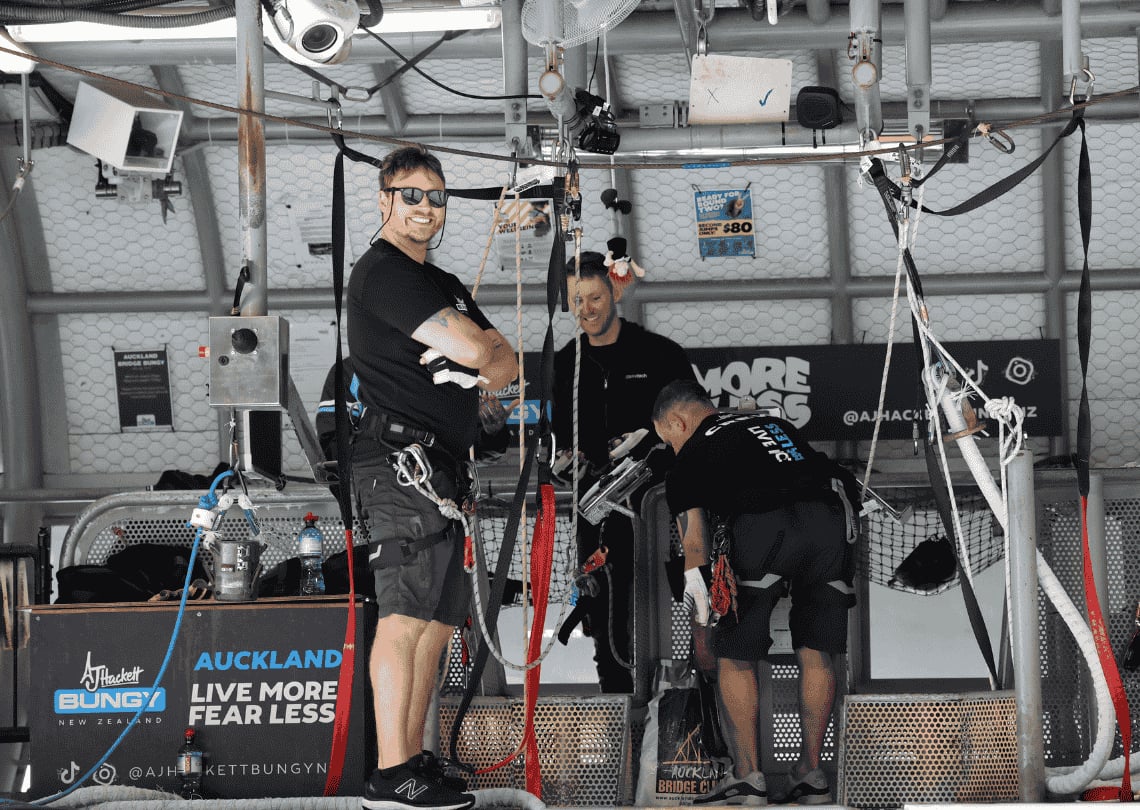
“Not long ago, we had a customer come in for his Stag do. He was absolutely terrified and was basically non-verbal the whole time. He eventually got out to the edge after a lot of pep talks and jumped straight away. His 12 mates that came out to spectate completely lost it and started cheering and clapping (most of them thought he wouldn’t do it). When he came back up, he was like a different person, completely relaxed and just happy and relieved. It was really nice to see someone genuinely terrified push through and conquer their biggest fear.”
How to Harness Psychology to Face Your Fears
Fear lives mostly in the mind. It’s your brain’s way of trying to protect you, often by imagining worst-case scenarios long before anything actually happens.
Because fear is created by our thoughts, it can also be managed through psychological techniques.
Kim provides these useful steps:
First, acknowledge that fear is perfectly normal and often accompanies stepping out of your comfort zone.
Then do any or all of the following (on repeat if necessary!):
- Manage fear by reframing — change the story you’re telling yourself (racing heart = excitement, not anxiety), and use your name: “Kim, you’re excited”.
- Settle your stress response with breathing. Try the Cyclic Sigh: take a deep breath in through your nose if you can, then top it off with a bit more, and follow with a long exhale. Do this once or twice. Alternatively, try a few rounds of Box Breathing: inhale for 4 seconds, hold for 4 seconds, exhale for 4 seconds, and hold for 4 seconds.
- Remind yourself why getting out of your comfort zone is a good idea. What’s your why? What benefits mean something to you? Do you see it as an opportunity to learn, grow, discover something about yourself, build your resilience, and strengthen your ability to face other challenges in life? Smile, and tell yourself “I’m doing this because…”
- Visualise yourself succeeding. Rather than focusing on the worst-case scenario (assuming the adventure is safe), imagine yourself going through it, picture the positive outcome, and feel the positive emotions. Whether it’s pride, joy, excitement, confidence, anticipate all the emotions you want to experience.
If the adventure is still too scary, Kim suggests breaking it into smaller steps:
- What’s a less intimidating step or less extreme version you could start with?
- If you fear a bungy jump, can you jump by sitting in the harness and stepping off, rather than being attached at the feet and diving headfirst?
- Can you do a tandem jump? A swing?
- If you fear going to a social situation alone, start small: decide how long you’ll stay (10 minutes), set a simple goal like saying hello to one new person, or go to an event where you know at least one person but arrive a few minutes before them.
Each small step helps your nervous system learn that the discomfort is manageable (and temporary!).
Simon explained: “Everything you’re feeling now will go away once you leave the platform. Yes, this is scary, but it’s meant to be, and that’s what makes it so fun. It’s very safe and I’ve jumped over 200 times myself, so I know what you’re going through right now, but trust me once you leave this platform and jump it is one of the best things you’ll ever do, so take a deep breath in, close your eyes if you need to, lean forwards and let gravity and the equipment take care of the rest.”
Kim’s final words on the matter: just do it.
“I know it’s a well-worn slogan, but if overthinking and catastrophising is your handbrake, replace those thoughts with a mantra (choose your own). Mine is ‘just do it, Kim, it’s not that hard, it’s not that deep.’”
For Simon, watching jumpers overcome fear is the most rewarding part of his job. “When you have a really difficult customer who is struggling to jump, and eventually you manage to get through to them and convince them to jump. That moment they lean forward and leave the platform, you just know they’re going to come back completely ecstatic, like a new person.”
Throughout his career, Simon has seen thousands of jumpers turn their fear into flight and reap the positive after-effects.
“If they’re really scared beforehand, I usually see them come up with a big smile and a massive sense of relief, and some people are absolutely buzzing.”
So there you have it. Bungy jumping is so much more than just a thrill… It is an epic battle with yourself that will leave you stronger on the other side.
The fear lasts minutes. The confidence can last much longer. Book your AJ Hackett bungy jump today and experience the positive after-effects for yourself.
FAQ’s
Can bungy jumping improve confidence and reduce anxiety?
Yes! For many people, facing a controlled fear like bungy jumping builds self-efficacy (belief in your ability to handle hard things). That can carry into everyday life as better stress tolerance, calmer self-talk, and more confidence in challenging situations.
How can I mentally prepare for my first bungy jump?
Start with simple tools: reframe nerves as excitement, use slow breathing (like Box Breathing or a Cyclic Sigh), and visualise a successful jump. If needed, take a smaller step first (such as a tandem experience or a less intense jump style) and build up from there.